

It's Monday morning and an email from your ATS vendor sits at the top of your inbox. A new "smart match" score is switched on by default for every job, from today. Nobody asked you. Your consultants have already noticed the small number beside each applicant, and one of them is sorting by it.
So does that score count as a decision about a candidate? Treat it as one until the three questions below show it isn't. That's my rule of thumb, not a legal finding. If a feature scores, ranks, filters or refuses candidates using their information, and your people lean on its output, the Privacy Act is likely to want it described in your privacy policy from 10 December 2026. On the sources reviewed below, a recruiter looking at the score doesn't change that. What the check changes is how you describe it.
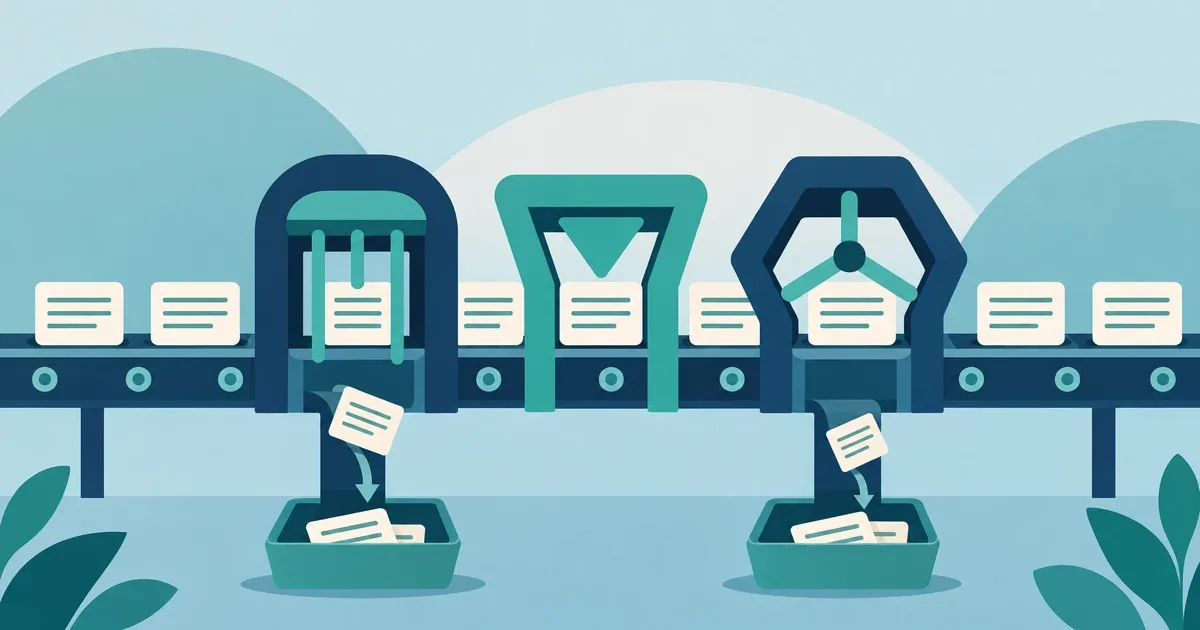
The way to settle it is three questions, asked of one feature at a time. Does it score, rank, filter or refuse? What does a person do with the output? Could the result significantly affect the candidate? This guide walks through each, runs six typical ATS features through them on one desk, and gives you a vendor email, a record to keep and a checklist for the next update. It isn't legal advice, and a privacy adviser makes the final call. But you can do the sorting yourself, and the adviser then starts from your notes instead of a blank page.
What the Privacy Act now asks you to say about automated decisions
The rule is new Australian Privacy Principle 1.7, added by the Privacy and Other Legislation Amendment Act 2024. It starts 24 months after Royal Assent, which was on 10 December 2024. That makes the start date 10 December 2026.
It is a disclosure rule. If you're covered, your APP privacy policy must contain certain information when three things are all true:
- You have arranged for a computer program to make a decision, or to do something "substantially and directly related" to making one.
- The decision could reasonably be expected to significantly affect the rights or interests of an individual.
- Personal information about that individual is used in running the program.
When all three apply, APP 1.8 says the policy must state three things. They are the kinds of personal information the programs use, the kinds of decisions made solely by a program, and the kinds of decisions where a program does something substantially and directly related to the decision.
Two details in APP 1.9 matter on a recruitment desk. First, "making a decision includes refusing or failing to make a decision". A feature that quietly drops an applicant counts. Second, a decision can affect someone's interests whether the effect is adverse or beneficial. A feature that pushes a candidate up the list affects them too.
The Act doesn't say the program must be artificial intelligence. "Computer program" is read broadly, so a spreadsheet or a knock-out rule counts, not only AI: the reading covers everyday software including spreadsheets, rule-based tools, machine learning and generative AI (Allens, 2 October 2026, summarising the OAIC guidance). The OAIC released that guidance on 30 September 2026, according to the same summary.
What about tools you already run? There's no grace period for settings you made years ago. The rule covers decisions made after the 10 December 2026 start, whenever the program was set up (Schedule 1, item 89 of the amending Act). So a screening rule you built in 2023 is caught from that day. Read plainly, there is no grandfathering for old configurations.
Say a client rings and asks why a candidate they rated highly wasn't on your shortlist, and the honest answer is "the score had him at 54". At that point the feature has stopped being a convenience. It's part of how you decide who goes forward, and you'd want it written down before the client asks, not after.
It's a transparency rule. No right for candidates to contest a decision, no duty to notify them one by one, no technical detail about how the system works. Commercial-in-confidence detail can stay out, but only where disclosure would "genuinely harm commercial interests", and mere commercial value doesn't qualify (Allens, 2 October 2026).
Do the new rules apply to your agency at all?
They bind "APP entities", and many small agencies may not be one. Under section 6D of the Privacy Act 1988, a business is a small business if its annual turnover for the previous financial year is $3,000,000 or less. The Queensland Government puts it plainly: small businesses with a turnover of $3 million or less are exempt from some components of the privacy legislation.
That exemption has exceptions, and one or two of them sit close to recruitment. Section 6D(4) says a business operator is not a small business operator if it "discloses personal information about another individual to anyone else for a benefit, service or advantage", or "provides a benefit, service or advantage to collect personal information about another individual from anyone else". There are others, for health services, Commonwealth contractors and credit reporting bodies.
Whether any of those fits how your agency works is a question for your adviser, not for a blog post. Ask it early, because the answer decides whether you need the rest of this work. Ask it in writing, and keep the reply.
Two more points on coverage. If you work inside a larger organisation, such as an internal talent team, the entity that matters is your employer, and its privacy lead probably owns the policy. That's my judgement, not a statutory finding. Say you're the talent lead and the ATS belongs to group HR: you won't write the policy, but your privacy lead will ask what each feature does on your desk. This guide gives you that answer.
A candidate you haven't hired probably isn't covered by the employee records exemption. That's my reading of section 7B(3), which ties the exemption to an employer's act that is directly related to a current or former employment relationship, and your adviser should confirm it. Piper Alderman (20 October 2026) notes the OAIC has not expressly addressed whether the use of information about an employee is exempted, and the article doesn't discuss candidates.
Audit features, not products
Most ATS audits go nowhere because they start with "is it AI?". Nobody can answer that, because one system holds a contact database, a duplicate checker, a ranked list and an auto-reject rule someone set up in 2022. Each of those gets a different answer.
So list features instead. Go through the product's settings, the vendor's release notes for the past year, your application forms and your job board connections. Write one line per feature that touches a candidate: what it's called, what it outputs, and where the output shows up for your people. Include things you didn't buy on purpose, because a vendor update that adds one still leaves you as the entity that "arranged for" the program. Say the vendor changes the default sort overnight. On Tuesday your consultants open a job and the list is in a different order. Nobody decided to change how you screen, and it has changed anyway. Allens' 10 June 2026 note flags exactly that uncertainty over embedded features in commercial software, and advises monitoring third-party tools during and after procurement.
The programme-level roadmap covers how to plan the whole job. This guide covers the unit of work inside it: one feature, three questions, one record.
Question one: does the feature score, rank, filter or refuse?
Start with what comes out of the feature. You're looking for any output about a person that a human could act on, and you need to keep the list wide. The outputs that count here are:
- a number, such as a match score or a fit percentage
- an order, such as a default sort or "best matches first"
- a gate, such as a knock-out question that hides or rejects an applicant
- a label, such as "strong", "review" or "unlikely"
- a generated summary or recommendation that stands in for reading the CV
Notice what's missing from the list: any mention of how clever the feature is. A rule that says "reject anyone who answers no to the work rights question" is a computer program in the sense the guidance uses. So is a ranked list produced by a language model. Hamilton Locke (4 June 2026) lists software that screens and ranks job applications as in scope. Its example of something out of scope is a formula that only calculates age from a date of birth: related to a decision, but not substantially related to one. My shorthand: if it doesn't change what anyone does next, it isn't steering.
This question also settles the personal information test. Ask what the feature reads. For an ATS the answer is almost always "the applicant's CV, answers and history", and that satisfies the test. But write it down anyway, because APP 1.8 makes you list the kinds of personal information used, and your record is where that list comes from. If the feature reads anything sensitive, such as health information from a reasonable adjustments request, flag it. Piper Alderman reports the OAIC expects sensitive inputs to be clearly flagged.
Then check for the quiet refusals. APP 1.9 says refusing or failing to make a decision counts. Auto-reject emails are obvious. Less obvious are the knock-outs that simply never create a candidate record, the job board filter that discards applications outside a radius, and the "not progressed" status a rule sets after fourteen days of no action. If a program decides that someone doesn't go forward, even by default, it belongs on the list.
If the feature produces none of these outputs, record that and move on. A calendar link that books an interview slot isn't scoring anyone.
Question two: what does a person do with the output?
This is the question people most often get wrong, so take it slowly. The tempting reading is "if a recruiter reviews everything, it isn't an automated decision". The sources don't support that reading.
Having a recruiter in the loop doesn't take a tool out of scope. What matters is whether they lean on the output. Allens' 2 October 2026 summary of the OAIC guidance says an output that is a "key factor with a direct connection to the human's decision" is generally caught, whether it advises or determines. Hamilton Locke says a human in the loop "does not necessarily take an arrangement outside the new framework". Squire Patton Boggs, in its October 2026 commentary, describes an OAIC example where staff can override a generative AI tool's profiles, yet the obligation still applies because they rely on the output when recording their reasons.
The Privacy Commissioner's counterpoint, as Squire reports it, is to go back to the statutory words: not everything that informs a decision is necessarily substantially and directly related to it. So the line exists. It just doesn't sit where "someone clicks approve" would put it.
Question two does two jobs.
It picks the bucket. APP 1.8 has separate lines for decisions "made solely by" a program and decisions where a program does something "substantially and directly related" to them. If an applicant who ticks "no" on a knock-out question is rejected with no human looking, that's the first bucket. If the score orders the list and a recruiter builds the shortlist from the top, that's the second.
It sets how strongly the output counts as a key factor. Allens lists the things the guidance looks at: how much people rely on the output, how likely they are to override it, whether it's advisory or determinative, whether they can explain it, and how deeply it's built into the process. You can test several of these on your own desk.
Here's a method to run. It's a practical check, not a legal test, and it has one catch. You need the score order as it stood on the day, and most ATS screens re-sort and re-score as new applicants arrive. So there are two routes.
Route one: ask the vendor. Ask whether the score and its rank are stored per job and can be exported. If they can, pull the last twenty shortlists across your desks. For each, note whether the people submitted to the client came from the top of the score order, in the same order.
Route two: run it forward. If the vendor can't give you that, start recording it yourself. For the next five jobs, have each consultant note the score rank of every candidate they submit, at the moment they submit. A shared sheet with one column is enough.
Either way, read the result the same way. If your consultants submit the top five in order nearly every time, the score is a key factor in practice, whatever the policy says. If they regularly skip it, you have evidence people weigh it themselves. That evidence helps you describe the feature honestly. It doesn't take it out of scope on its own.
A second test: hide the output and ask the consultant what they'd do. If the answer is "I'd open the CVs in the order they arrived", the feature has decided whose CV gets opened first. If the answer is "I'd do exactly what I did", you've learned something real about how much the output matters.
Also look at what the reviewer sees. A score with no reason attached is harder to challenge than one that lists the three CV fields behind it. Say a reviewer is rushed on a Friday, with 140 applicants and a client call at four. They won't interrogate a number. Record how long people realistically have, and whether the screen lets them open the underlying CV in one click.
Question three: does the outcome significantly affect the candidate?
The statute asks whether the decision "could reasonably be expected to significantly affect the rights or interests of an individual". It gives examples in APP 1.9: a decision about a benefit under an Act, a decision affecting rights under a contract or arrangement, and a decision affecting access to a significant service or support. Jobs aren't named in those examples.
Commentators put recruitment screening in scope anyway. Automated recruitment screening and candidate ranking tools are listed as relevant use cases, with a warning not to limit the review to fully automated systems (Holding Redlich, 15 October 2026). An OAIC fact sheet example, in which AI screens out lawyer candidates who lack a law degree, is read as meeting the significance threshold (Squire).
For your own features, ask what happens to a candidate because of the output:
- Does it decide who gets a conversation, a submission to a client, or an interview?
- Does it decide who is never read at all?
- Does it change the terms offered, such as a pay band suggestion?
- If the output is wrong, how would the candidate find out?
Say the score pushes a strong contractor to page two the week a client needs someone by Friday. The consultant never calls him. He never knows. On a contract desk the same score decides who gets the four o'clock call, and by Friday that is who gets placed. That's the kind of effect this question is asking about.
Be careful about the other direction too. Effects can be beneficial as well as adverse, so don't discount a feature because it only "promotes" people. A ranking that lifts one candidate lowers another.
Some features will fail this question honestly. A tool that formats a CV into your submission template changes how a document looks, not whether someone is considered. Record that conclusion with a reason. "Formatting only, no selection effect" is a fine entry. "Not important" is not.
One unsettled corner is worth naming. Allens' June note says the OAIC's issues paper asks whether a candidate who never sees a job advertisement has been subject to a "decision" at all, and that the answer is uncertain. If you use targeting or audience tools to decide who sees your adverts, put them on the list as open questions for your adviser rather than guessing.
Worked example: six features on one perm desk
Say you run a perm desk of four, and the vendor's release email lists six features. The names and behaviours here are hypothetical, so swap in your own. The "first pass" column is how I'd sort them before the adviser sees them. It is not a legal conclusion.
| Feature (hypothetical) | Q1: score, rank, filter or refuse? | Q2: what a person does | Q3: significant effect? | First pass |
|---|---|---|---|---|
| Smart match score, default sort | Yes: a score and an order, using CV text and history | Consultants build shortlists from the top of the list | Decides who is read and submitted | Likely in scope, "substantially and directly related" line |
| Knock-out questions with automatic "not progressed" email | Yes: a filter that refuses | Nobody sees the rejected applicants | Applicant is screened out of the job | Likely in scope, "made solely by" line |
| Duplicate candidate flag | A flag, not a score, rank or refusal; uses name and contact details | Consultant confirms before merging | Housekeeping, no selection effect on its face | Probably not, record the reason |
| Generated CV summary at top of profile | Output is a summary, not a score | Some consultants read only the summary | Depends on whether it replaces reading the CV | Grey: test it, ask the adviser |
| Interview booking links | No score, rank or filter | Candidate picks a free slot | Scheduling convenience | Probably not, record the reason |
| Talent pool keyword search | A search the consultant controls, possibly re-ranked | Consultant reads the results | Decides who surfaces for a new job | Grey: find out whether results are re-ranked by a hidden score |

Walk through the three that matter most.
The smart match score. Question one is a plain yes. It outputs a number and an order, and it reads CV text, job history and probably location. Question two takes more care. Your four consultants are good, and they do read CVs. But when you run the shortlist check, three of the four submit the top five in order on most jobs. Ask one of them why and you'll hear "I just start at the top and work down, it's faster." That's exactly the sentence you're listening for. The score is acting as a key factor even though a human makes the final call, and what you say back isn't "stop". It's "then we describe it that way and write down how we check it." That puts it on the "substantially and directly related" line. Question three is clear enough: the order decides who gets a call.
The knock-out email. This one is the cleanest case in the table, and the worst news. A rule rejects applicants who answer no to a minimum-experience question and emails them. No one reviews the rejected group. That's a decision made solely by a program, and the refusal is exactly what APP 1.9 says counts. Check the rule's wording too. A question like "Do you have 5 years of experience?" can screen out people the client would happily see. That's a fairness issue, and the guide to proxy discrimination in screening rules deals with it. Disclosure doesn't cure a bad rule.
The generated summary. This is the grey one, and it's grey for a good reason. A summary isn't a score. But if consultants stop opening CVs for applicants whose summary reads weakly, the summary is steering the decision. You can't resolve that by reading the feature description. You resolve it by watching how people work. Sit with a consultant for twenty minutes, or ask them to record which applicants they open in full. Then write down what you saw.
The result for this desk is two likely disclosures (one in each bucket), two open questions and two records of reasoning. Most systems don't produce a clean sort, and what matters is that each line has a reason someone else can read.
What to ask your ATS vendor, and what to keep
You can't answer these questions about a feature you don't understand, and the vendor holds the facts. The obligation stays with you. It sits "with the entity that procured and deployed such system, not the third party supplier" (Hamilton Locke, 4 June 2026). Meeting APP 1.8 also depends on suppliers giving clear, high-level information about how their software can be used to make decisions, and overseas suppliers may be reluctant to give it (Squire). So ask in writing, and ask specific questions. If you end up on a call instead, print questions 1, 2 and 9, read them off, and ask for the written reply afterwards.
Here is an email you can adapt. Send it to your account manager, with your privacy lead copied in. Question 9 goes to the contract owner or the vendor's legal contact, because an account manager can't answer it.
Subject: Smart match score: what it does and what it uses
Hi [name], thanks for the release note about [feature]. We're updating our privacy records before 10 December 2026, so please reply to the questions below by [date].
- In one sentence, what does this feature do, and what output does it give for each candidate: a score, an order, a label, a filter or a summary?
- What information about the candidate does it use? Please list the fields, including anything from assessments, notes or attachments.
- Is it on by default, and who can switch it off? Can that be done per job, per team or only for the whole account?
- What does a recruiter see on screen? Is there a reason or an explanation next to the output, and can they open the underlying record in one step?
- Does anything happen to a candidate automatically because of the output, such as a status change, an email or a hidden record?
- When was it switched on for our account? How will you tell us before you change its logic, its data or its default?
- Does it use a third-party model or service, and where is candidate data processed?
- What can you give us in writing, without trade secrets, that describes the feature accurately enough for our privacy policy?
- Under our contract, who is making the decision when this feature is used?
The last question comes from Squire's point that entities should make clear in contracts who holds ultimate decision-making responsibility. Ask it anyway, and keep whatever reply you get.
For the wider supplier conversation, the security questionnaire for recruitment AI vendors has a response record you can reuse.
Keep one record per feature. These are the fields:
| Field | What goes in it |
|---|---|
| Feature and system | Name, vendor, and the date it was switched on |
| Owner | The person who answers for it |
| Q1 answer | Output type, and the personal information used |
| Q2 answer | What people do with it, and the evidence (shortlist check, observation) |
| Q3 answer | Effect on the candidate, with the reason |
| Vendor reply | Date, who replied, and the file |
| Bucket | Made solely by the program, substantially and directly related, neither, or unsure |
| Adviser decision | The decision, the date and the assumptions behind it |
| Policy wording | The version that describes it |
| Review trigger | What change sends it back for review |
If you already keep a log of what an AI proposed and who decided, the AI audit log template shows one way to separate the proposal from the human decision. The same habit helps here.
What to disclose, and where
Once the adviser has made the call, the work becomes writing. APP 1.8 asks for kinds, not details. Allens reports the OAIC guidance is "not prescriptive", that separate processes with different outcomes, purposes or information should be identified separately, and that more sensitive data should be called out more clearly. Piper Alderman adds that the OAIC expects entities to make it easy for people to ask for more information.
For the hypothetical desk above, entries might read like this. They're illustrations of the structure, not wording to copy.
- Kinds of personal information used: the contents of CVs and applications, work history, and answers to screening questions.
- Kinds of decisions made solely by a program: whether an applicant who answers no to a minimum requirement question progresses to review.
- Kinds of decisions where a program does something substantially and directly related to the decision: the order in which applicants are shown to recruiters when they build a shortlist.
Describe what the feature does, not what you wish it did. Don't write that a recruiter reviews every applicant if the knock-out rule means nobody sees the rejected group. And don't copy another employer's text, because a disclosure written for someone else's setup is wrong for yours.
Where does it go? The statute puts it in your APP privacy policy. Holding Redlich also recommends reviewing collection notices alongside privacy policies, and it makes sense to check your application forms and job ad templates for text that now contradicts the policy. Put one person in charge of publishing it, and keep the dated approval with the record.
A checklist for the next system update
Back to Monday morning and the vendor email. You won't audit your whole system each time something changes. You need a short routine for the next email. Use this one:
- Stop and name the feature. Put it on the list with the date the vendor says it starts.
- Find out whether it's on by default and who can switch it off. If you can, turn it off for a pilot desk first.
- Run the three questions and write the answers in the record.
- Send the vendor email, with the date you need answers by.
- Check what your consultants see on screen. Did a default sort change? Did a new column appear?
- Compare the outcome with the current policy wording. If the feature belongs in a disclosure and isn't there, tell your privacy lead before it goes live on more desks.
- Set the review trigger: a new data source, a change to the score, a change to the default, or a new model behind it.
A "set and forget" approach won't support ongoing compliance, as Hamilton Locke warns. The supplier reacceptance checks for workflow changes show how to turn monitoring into a standing step, so that a vendor can't change your risk by sending an email.
Grey areas and objections
"Our vendor says it isn't automated decision-making." Fine, but the vendor isn't the entity that has to disclose (see the vendor section above). Ask what the feature does, and decide for yourself what that means.
"We'll list everything to be safe." Over-disclosing is tempting, and Squire says some organisations may choose to do it because the line between levels of human involvement is hard to draw. But a policy that describes features you don't use, or claims decisions you don't make, is inaccurate in the other direction. Be specific instead. Describe what each feature does and where a person comes in.
"We're too small for this." Maybe, but don't decide it from the size of your office. It depends on the section 6D threshold and its exceptions, covered above. Ask the adviser and record the answer.
"Disclosing means we've dealt with fairness." It doesn't. This rule requires a description of what you do and has nothing to say about whether a screening rule is fair. It creates no right to contest a decision either. A knock-out rule that screens out good candidates is still a bad rule with a good policy paragraph. Audit the rule separately.
"A client's system does the ranking, not ours." Then the question is who arranged for the program. It may be the client, you, or both in different ways, and the answer can turn on your contract and how your people use the output. Write down what you know and ask your adviser. Don't assume the rule skips you because the software isn't yours.
Running the same three questions on FluxHire
Put it to the team as question one for each feature you plan to use: does it score or rank? This post can't answer that for you, and I'm not going to claim it either way. Keep the reply in your record.
If you evaluate FluxHire, run the same audit on it, and don't take a sales page's word for how a feature behaves, ours included. During early access, teams evaluate FluxHire alongside their current ATS/CRM, and supported records, integrations and review steps are confirmed with each team.
What I can say is narrower. In the workflow where an AI agent proposes a change to a record, the change is written only once someone approves it, an unapproved change expires after ten minutes, agents can't delete records, and AI-planned actions go to a tamper-evident audit log. Set that against the ten-field record above. It gives you material for the Q2 answer: what a person approves, and what's written down afterwards.
It gives you nothing for Q1 or Q3, and it can't fill in the bucket or the adviser's decision. Those need the team's answers for your workflow, so ask them to walk you through the review steps you plan to use, and put what you see through your record.
If you want to start that conversation, request early access and bring your feature list and this record.
How FluxHire handles security lists the questions to settle before using recruitment AI with candidate data.
What the next vendor email looks like
It's another Monday. An email arrives from the vendor, and this time you don't open it with dread. You add the feature to the list and see that it's switched on by default. You've got a record with two likely disclosures, two open questions and two reasoned "probably not" entries from the last audit, and you know which of your four consultants to ask about the new summary.
You send the nine questions before lunch. You check the screen your consultants see. If the feature belongs in the policy, your privacy lead hears about it this week and not on 9 December. The score might still be useful. The point is that you decided how it gets used, and you can show your working.
Frequently asked questions
Does my ATS have to use AI to count as making automated decisions?
No. The Act refers to a "computer program", and Allens reports the OAIC reads that broadly, including rule-based tools and even spreadsheets. What counts is whether the feature makes a decision or does something substantially and directly related to one. A simple knock-out rule can count where a clever tool that only formats CVs doesn't.
If a recruiter reviews every score, am I out of scope?
Not on the sources reviewed in this guide. Human involvement changes how you describe the feature, and it stays in scope where the output is a key factor in the person's decision (see question two above). Your adviser should confirm the position for your setup.
Do I have to tell every candidate that a program scored them?
APP 1.7 to 1.9 don't require individual notification, according to Allens. They require your privacy policy to describe the kinds of personal information used and the kinds of decisions involved. Other legal and practical reasons to tell candidates may still apply, so ask your adviser.
Does this apply to my agency if turnover is under $3 million?
It may not, but check. Section 6D of the Privacy Act treats a business with turnover of $3,000,000 or less as a small business, with exceptions your adviser should test against how your agency works.
Do the rules cover tools I already use?
Yes. The rule applies to decisions made after 10 December 2026, whenever the program was set up, so a screening rule from years ago is covered from that day.
Sources
- Privacy and Other Legislation Amendment Act 2024, Schedule 1, Part 15, Federal Register of Legislation, Royal Assent 10 December 2024
- Privacy Act 1988, sections 6D and 7B, Federal Register of Legislation, compilation of 14 October 2024
- Protecting privacy and information, Business Queensland, Queensland Government, undated
- Mandatory automated decision-making disclosure requirements are coming: key takeaways from the OAIC guidance, Allens, 2 October 2026
- Automated decision-making transparency: what APP entities need to know about the APP 1 amendments, Allens, 10 June 2026
- Who decides? Australia's new guidance on automated decision-making raises the bar, Squire Patton Boggs, October 2026
- Transparency in automated decision-making: what regulated entities need to know and do before December 2026, Hamilton Locke, 4 June 2026
- OAIC guidance and how private sector organisations can prepare, Holding Redlich, 15 October 2026
- When the machine decides: is your privacy policy compliant with new automated decision-making transparency requirements?, Piper Alderman, 20 October 2026